SHARED STEWARDSHIP
ON EARTH AND IN SPACE
SHARED STEWARDSHIP: On Earth and in Space
WHAT IS SHARED STEWARDSHIP?
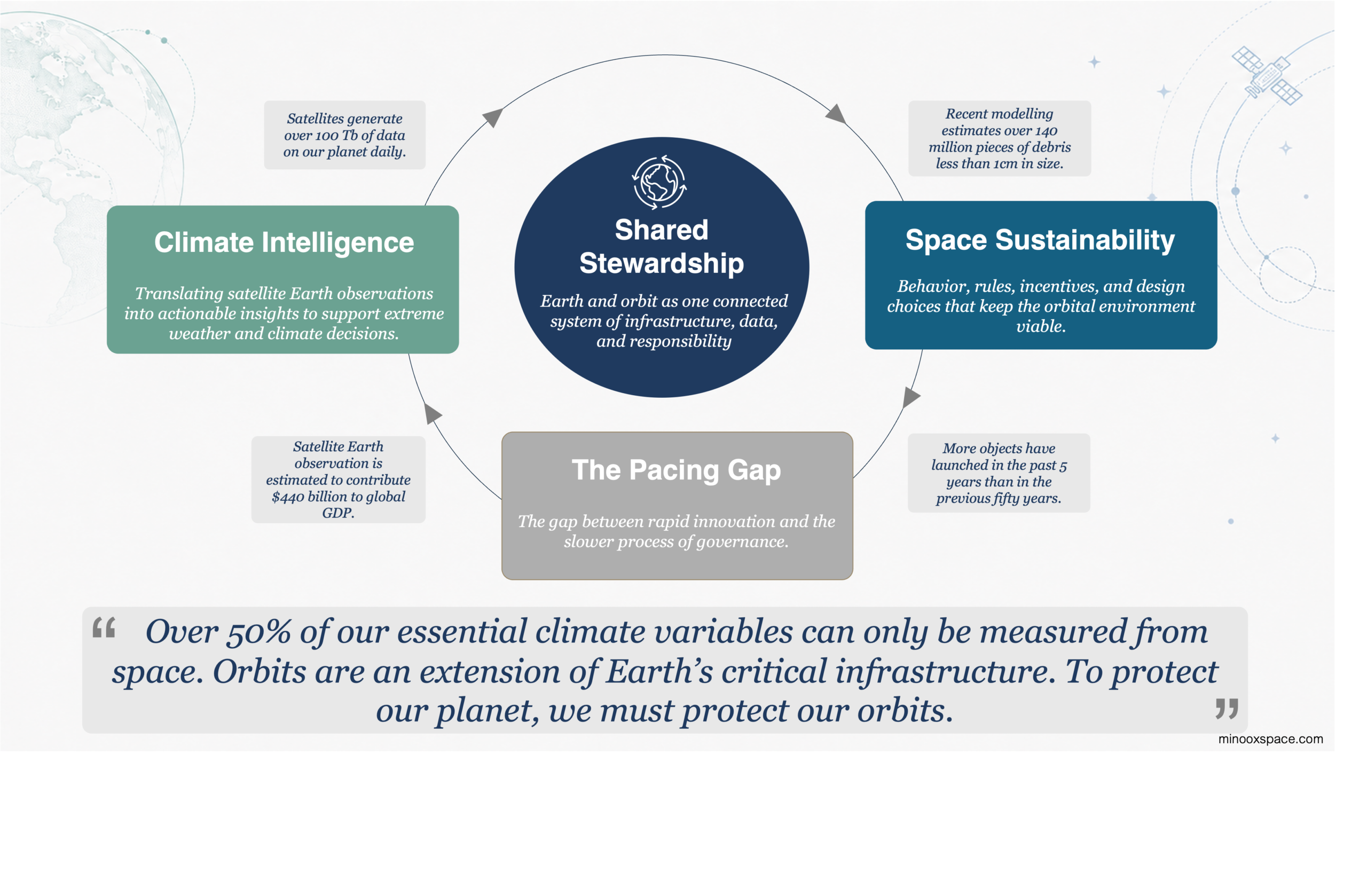
Shared Stewardship is a framework for understanding sustainability on Earth and sustainability in orbit as one connected challenge.
The satellites we rely on to monitor extreme weather events, climate change, respond to disasters, communicate, navigate, and make decisions all operate in an orbital environment that is becoming more congested and more fragile. It begins with a simple recognition: Earth’s orbit is an extension of our critical infrastructure – as essential as power grids, water systems, or the internet. Shared Stewardship argues that Earth and orbit should not be treated as separate domains. They are part of one connected system of infrastructure, data, and responsibility.
Shared Stewardship sits at the intersection of climate sustainability and space sustainability; a space that, until recently, did not have a shared vocabulary. Climate scientists, engineers, and policy-makers often work on connected challenges in seperate rooms. Over the past several years, my work has focused on building that vocabulary. The three concepts: Climate Intelligence, Space Sustainability, and the Pacing Gap make up the framing I use to describe Shared Stewardship: On Earth and in Space.
CLIMATE INTELLIGENCE: EARTH OBSERVATION-ENABLED DECISION-SUPPORT
Satellites generate over 100Tb of data on our planet every day from sea-level rise and atmospheric composition to monitoring floods and wildfires. But data alone does not drive decisions. My work focuses on climate intelligence: turning Earth observation, AI, and immersive visualization into actionable insight for policymakers, industry, communities, and the public. This work asks how climate data can become more usable, more trusted, and more connected to decisions around resilience, disaster response, investment, and adaptation.
- Charting the Future of Earth Observation: Technology Innovation for Climate Intelligence
- Earth Mission Control: Global-to-local Decision Support Intelligence
- Space Technology and the 17 Sustainable Development Goals
SPACE SUSTAINABILITY: SAFEGUARDING THE ORBITAL ENVIRONMENT
The rapid expansion of the space sector, driven by innovative business models and emerging technologies, is testing the long-term viability of the orbital environment we depend on. This unprecedented growth far exceeds historical trends, raising urgent questions about the safety, stability, and accessibility of Earth’s orbital pathways for future generations. Without proactive strategies, the increasing density of space objects could jeopardize the orbital environment we all rely on.
- Closing the Pacing Gap: How emerging space nations are influencing sustainability norms
- Space Sustainability Rating in support of the development and adaptation of regulatory guidelines related to long-term sustainability
- The role of emerging space nations in ensuring long-term space sustainability
THE PACING GAP: TECHNOLOGY vs. GOVERNANCE
The Pacing Gap refers to the growing distance between rapid innovation and the slower, iterative process of governance in the space industry. This work examines how space governance can keep pace with technical change while remaining adaptive, inclusive, legitimate, accountable, and worthy of public trust.